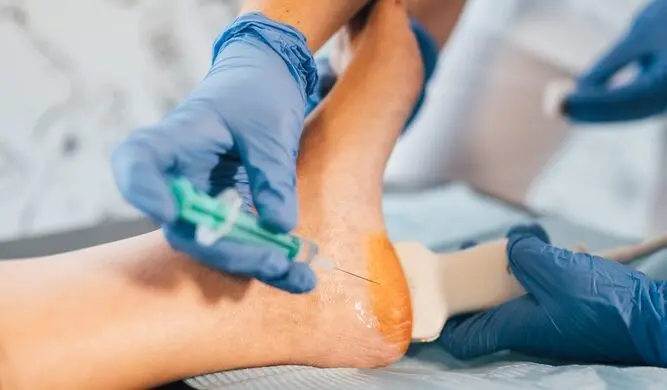
Platelet-rich plasma injection utilizes the body’s natural healing ability to stimulate tissue repair.
If you are suffering from plantar fasciitis or chronic tendinitis in the foot, this podiatric treatment could speed up your recovery and reduce your pain.
Continue reading to learn more about how this treatment works and how it is performed.
What Is a Platelet-Rich Plasma Injection?
A platelet-rich plasma (PRP) injection is a medical procedure that involves injecting a concentrate of platelets, obtained from the patient’s blood, into a joint or tendon.
This intervention, which can be used in podiatry to treat plantar fasciitis and tendinitis in the foot, aims to stimulate tissue healing and reduce pain.
Plasma, Platelets, and Platelet-Rich Plasma
Plasma is the liquid part of the blood. Blood cells—red blood cells, white blood cells, and platelets—are suspended within it.
While red blood cells carry oxygen and white blood cells fight infections, platelets, also called thrombocytes, play a crucial role in wound healing.
During a PRP injection, a blood sample is taken from the patient. This sample is placed in a centrifuge, which separates the platelets from the other blood cells.
This is how platelet-rich plasma is obtained (its platelet concentration is up to more than six times higher than the body’s normal production), which is then injected into the area to be treated to stimulate tissue repair.
Platelet-Rich Plasma Injection for the Treatment of Plantar Fasciitis and Tendinitis in the Foot
If you suffer from plantar fasciitis or chronic tendinitis, a PRP injection could be among the treatments recommended by your podiatrist.
- Plantar fasciitis is an inflammation of the plantar fascia, a thick and elastic tissue that connects the heel bone to the toes. It manifests as heel pain, especially during the first steps in the morning or after a period of rest.
- Tendinitis is an inflammation of a tendon. In the foot, it is often observed in the Achilles tendon. The main symptoms are pain behind the ankle that worsens during physical activity, along with tenderness of the tendon to the touch.
In these conditions, injecting platelet-rich plasma at the injury site helps stimulate the body’s self-healing capacity. Platelets contain growth factors that, when released into the blood, promote tissue healing, thus helping to accelerate the recovery of a damaged tendon, for example.
How Long After a PRP Injection Can an Improvement Be Noticed?
Generally, patients will feel an improvement in their symptoms within a few weeks following the injection. However, treatment outcomes vary from person to person, and its effectiveness cannot be guaranteed.
Who Can Receive a Platelet-Rich Plasma Injection?
A platelet-rich plasma injection is a therapeutic option indicated for individuals who suffer from tendinitis or plantar fasciitis that is slow to heal or causes severe pain.
This intervention is also often used among athletes to treat various musculoskeletal injuries. Because it accelerates the natural healing process, PRP injections help athletes recover and return to physical activity more quickly.
Moreover, when conventional treatments such as anti-inflammatory medications, rest, orthotic use, or physiotherapy have failed, platelet-rich plasma injection offers an additional treatment option to aid patient recovery without surgery.
For example, if usual advice to heal chronic Achilles tendinitis does not relieve the pain, PRP injections may be considered as a foot treatment.
How Is a Platelet-Rich Plasma Injection in the Foot Performed?
Before the Treatment
The patient must have previously consulted a podiatrist to determine if a PRP injection is appropriate for their condition.
At least two weeks before the procedure, the patient must stop taking anti-inflammatory medications and must not take antiplatelet or anticoagulant drugs.
Additionally, the patient must not have received a cortisone injection within the three months prior to the PRP injection.
During the Treatment
The healthcare professional first draws a blood sample from the patient. The blood is then centrifuged to separate the platelets from the red and white blood cells. The resulting platelet concentrate is then injected at the injury site.
The professional may use ultrasound guidance during the procedure, known as an ultrasound-guided injection. This technique allows visualization of the needle position inside the foot to accurately target the treatment area.
After the Treatment
Moderate pain may be experienced in the first few days following the injection. Apart from this, the treatment has few side effects.
Recovery time is around two to three weeks. During this period, the patient should minimize physical effort and avoid anti-inflammatory medications, as these could interfere with the natural PRP response.
A follow-up appointment with the podiatrist may also be scheduled to assess treatment response.
Relieve Your Foot Pain with a Platelet-Rich Plasma Injection
If you believe a PRP injection is a foot treatment that could benefit you, do not hesitate to contact a PiedRéseau clinic for an evaluation of your condition.
If this treatment is not appropriate to heal your injury, the podiatrist may suggest another type of injection used in podiatry, such as a cortisone injection or a hyaluronic acid injection.